Different wireless architectures behave very differently in real monitoring deployments. This page provides technical context on the main options used in HACCP and similar applications.
Coverage, infrastructure, power consumption and device dependency all shape how a monitoring system is installed, scaled and maintained. The core distinction is often between systems that require supporting infrastructure and systems that can communicate directly over longer distances.
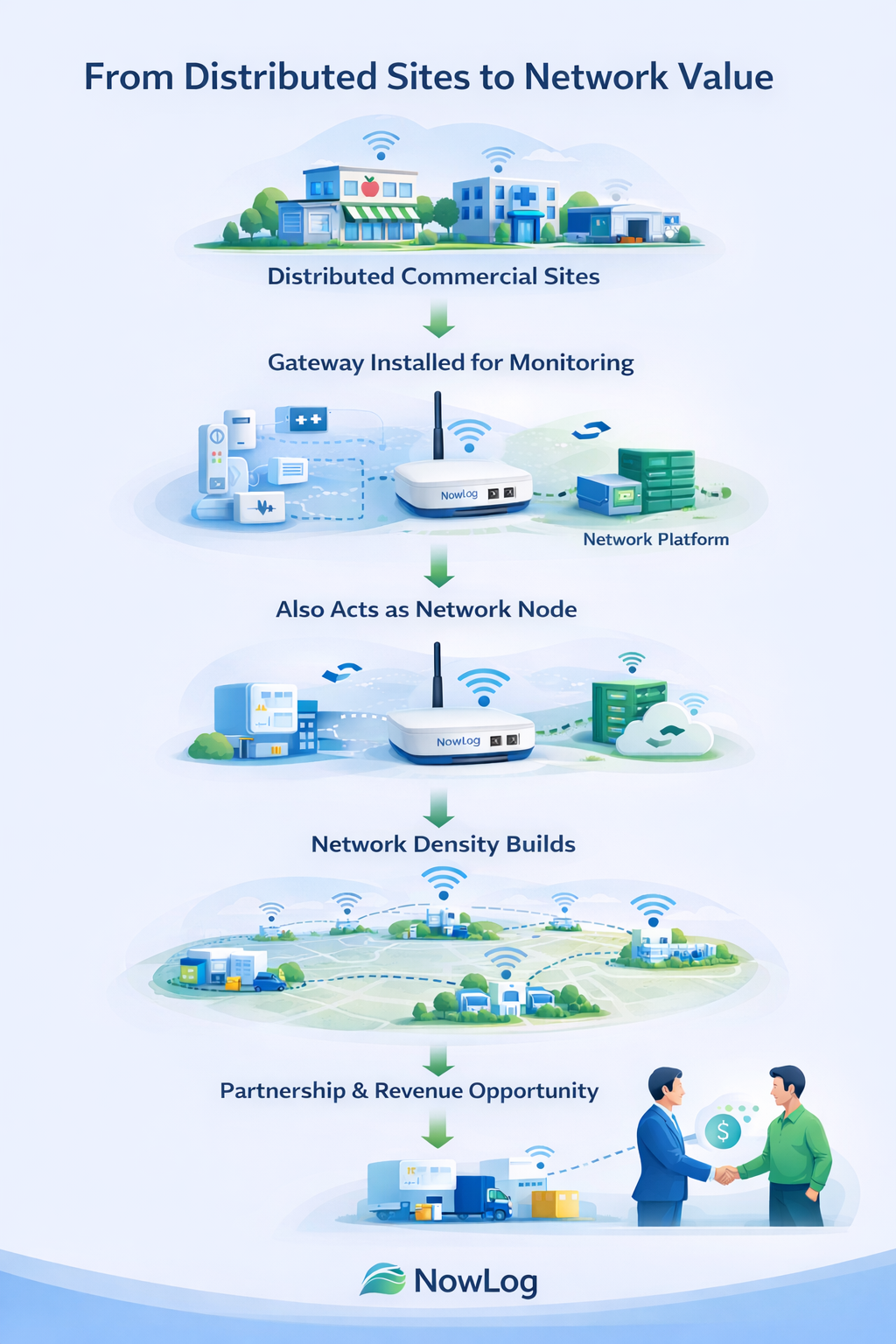
How distributed sites can create scalable LoRaWAN infrastructure
Read the Perspective PaperThe sections below summarise the main wireless approaches used in monitoring systems and the practical trade-offs they introduce.
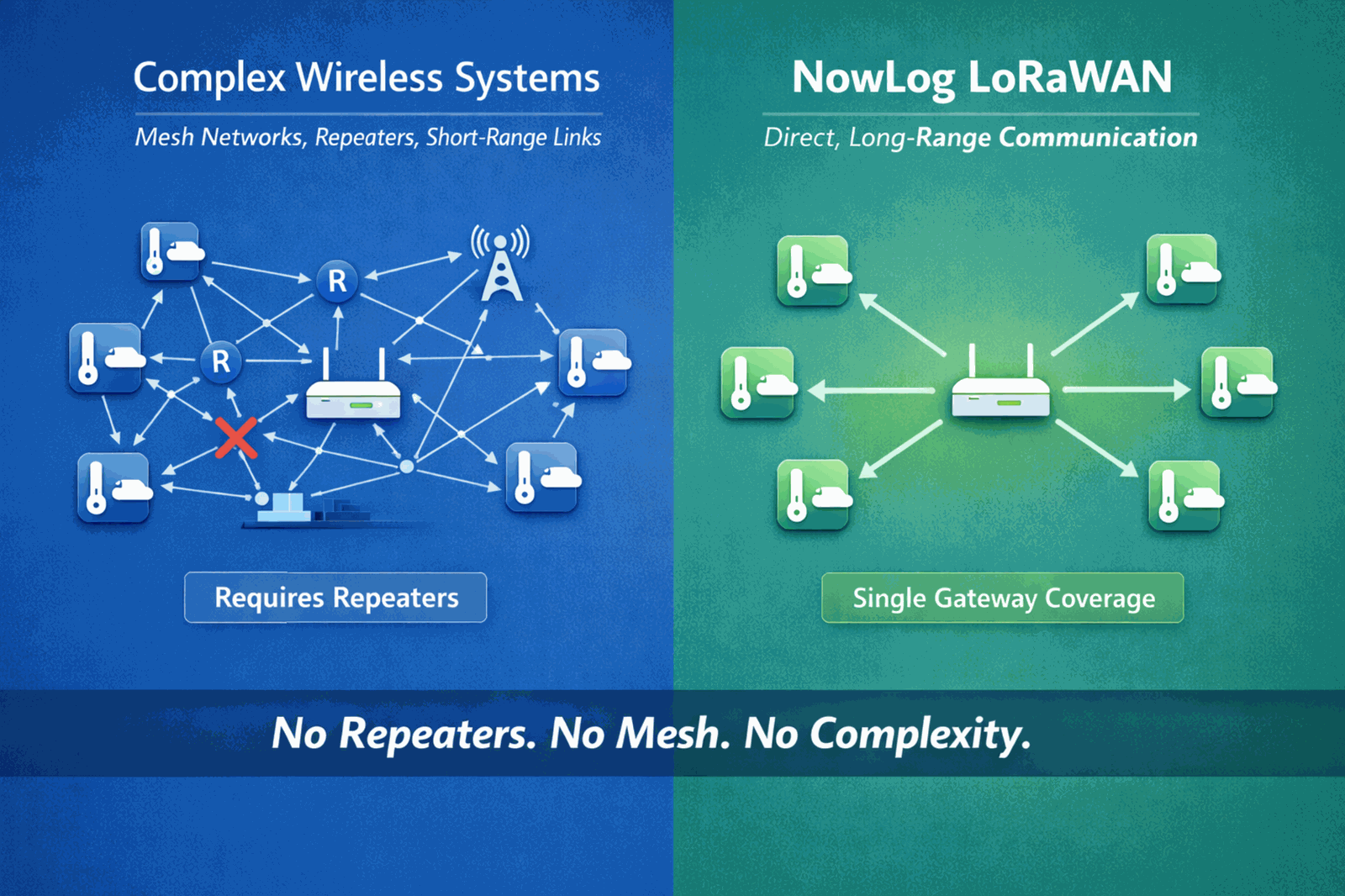
LoRaWAN is designed for low-power, long-range communication and is particularly well suited to fixed monitoring deployments. It typically allows a large area to be covered from a single gateway, while keeping sensor power consumption low enough for multi-year battery operation.
Its practical advantage is architectural simplicity. Sensors communicate directly to the gateway rather than relying on other sensors to relay traffic. This reduces infrastructure overhead, limits dependency between devices and avoids the engineering burden associated with repeater or mesh-based systems.
Bluetooth is widely used in food safety, particularly for handheld probes and short-range local measurements. It integrates naturally with phones and tablets and is therefore very effective for user-attended activities such as spot checks and manual recording.
Its limitation is range. Even with newer long-range or PHY-coded modes, Bluetooth remains a relatively short-range technology compared with LPWAN options. For continuous unattended monitoring across a site, this often means more receivers, more gateways or closer device placement.
Wi-Fi-based monitoring systems use existing local wireless networks to connect sensors directly to cloud platforms.
This approach works well in environments where strong and consistent Wi-Fi coverage already exists, such as laboratories, hospitals, and modern commercial buildings.
Strengths:
Limitations in monitoring deployments:
In practice, Wi-Fi monitoring systems rely on the assumption that the building already provides complete and reliable wireless coverage. Where this is not the case, additional infrastructure or configuration is required.
There are several narrowband wireless systems operating in the 868 MHz band in Europe and the 915 MHz band in the US. These can achieve useful range, but in practical deployments they often require repeaters or a greater density of gateways to reach difficult locations reliably.
That makes the system more infrastructure-dependent. As coverage requirements grow, hardware count, installation effort and maintenance overhead tend to grow with them. The result can be a more engineered deployment, especially on larger or more complex sites.
ZigBee has the advantage of operating in the globally available 2.4 GHz band and has been used successfully in many building and automation applications. However, the power limits and propagation characteristics of that band mean range is typically extended by having devices relay each other's data.
This creates dependency chains within the network. As installations grow, fault diagnosis and maintenance can become more complex because a communication problem may be caused not only by the affected sensor, but by another device in the route.
Cellular technologies are very effective where assets are mobile or distributed over large geographic areas. This makes them attractive for transport and cold-chain logistics, where direct access to public telecom infrastructure is valuable and SIM costs have become much more practical than they once were.
For dense fixed-site monitoring, however, the trade-offs are different. Devices generally consume more power, recurring connectivity costs apply and the system depends on external operator infrastructure. NB-IoT and LTE-M improve efficiency for IoT use cases, but they still remain operator-dependent solutions rather than local site architectures.
Operator-based LPWAN services such as Sigfox can provide low-power wide-area connectivity without requiring private local infrastructure. In the right geography and the right application, they can be attractive.
The constraint is coverage and commercial dependence. These systems are only as useful as the network availability in the regions being served, and ongoing service pricing forms part of the deployment model. For multi-site monitoring programmes, that can introduce variability that does not arise in a self-contained local architecture.
The underlying communication model determines whether a monitoring system stays simple as it grows, or accumulates infrastructure, dependency and maintenance overhead over time.